
Garage Door Cable Replacement in Hartford, CT: What It Costs, Why It Failed, and How to Keep It From Happening Again
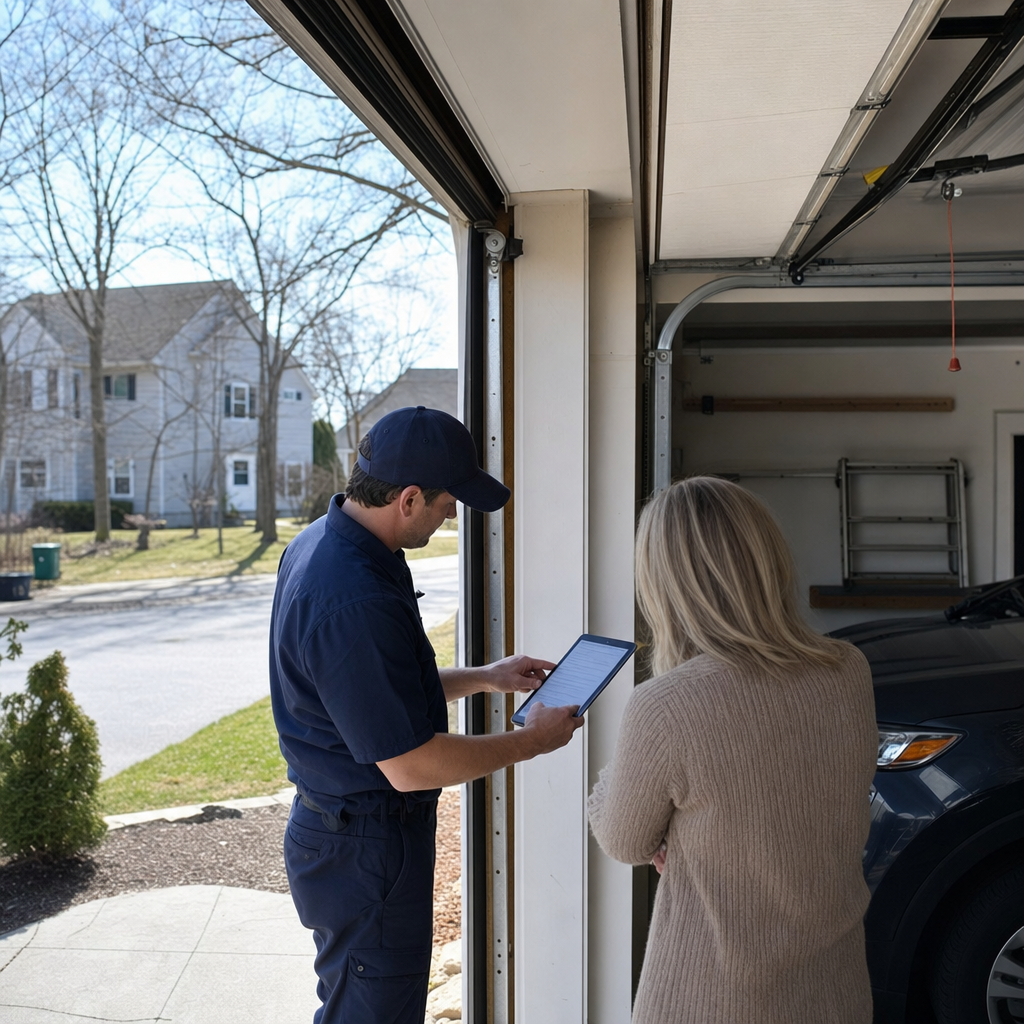
Garage door cable replacement in Hartford typically runs $130–$250 for standard residential doors and can usually be completed same-day. Call (833) 569-0621 for a free estimate — we’ll confirm the exact cable gauge your door needs and check whether your bottom seal or drum condition caused the failure in the first place. At Coastal Garage Door Repair Greater Hartford, Mark Thompson handles every cable job personally, and in eleven years of single-trade work, he’s learned that replacing a cable without finding out why it snapped is just setting a timer for the next service call.
Why Hartford Cables Fail: The Frozen Seal Problem Nobody Talks About
On a January morning in Frog Hollow or Asylum Hill, the temperature dropped hard overnight. Your garage door’s rubber bottom seal bonded to the concrete apron like a suction cup. The opener motor fired at 6:15 a.m., the door didn’t budge, and the full tension load — hundreds of pounds of stored torsion spring force — transferred onto a single stress point at the bottom bracket drum. The cable didn’t just wear out. It got murdered.
We’ve seen this exact failure pattern hundreds of times across Hartford’s older neighborhoods. The Connecticut River Valley frost pocket delivers sharper freeze-thaw swings than coastal cities like New Haven or Bridgeport. Water seeps into hairline cracks in the concrete, expands overnight, and by morning your seal is frozen solid. The opener doesn’t know that — it just pulls. Something has to give, and it’s almost always the cable at the drum, where the bend radius is tightest and the metal is already working hardest.
Here’s what frustrates us: a technician swaps the cable, charges you, and leaves. Three months later, same door, same freeze, same snap. The cable was never the root cause. The root cause is a seal that isn’t sealing and a concrete apron that holds water instead of shedding it.
Mark’s Hartford Winter Protocol
When we replace a cable in Hartford between November and March, we run a three-point check that most chain operations skip:
- Bottom seal condition: Is it cracked, hardened, or sitting too low? A pliable seal with proper contact pressure won’t bond to ice the way a weathered one does.
- Concrete apron assessment: Does the pad pitch away from the door, or does it have low spots that collect meltwater? In West End carriage-house conversions with century-old dirt or cracked concrete floors, moisture accelerates cable rust at the drum before freezing even becomes a factor.
- Drum and bottom bracket inspection: Is the drum grooved or worn from previous cable slip? A damaged drum chews through new cables in months, not years.
We’ve learned this the hard way. Early in Mark’s career, before he developed this protocol, he replaced the same customer’s cable twice in one winter in a Frog Hollow triple-decker garage. Third visit, he finally looked past the cable. The concrete was pitched toward the door, creating a permanent puddle zone. Fixed the drainage, replaced the seal, swapped the drum — that customer hasn’t called for cable work in eight years. “If I wouldn’t put it on my own garage, I won’t put it on yours.” That’s the standard we work to.
What Cable Replacement Actually Involves (and Why the Gauge Matters)
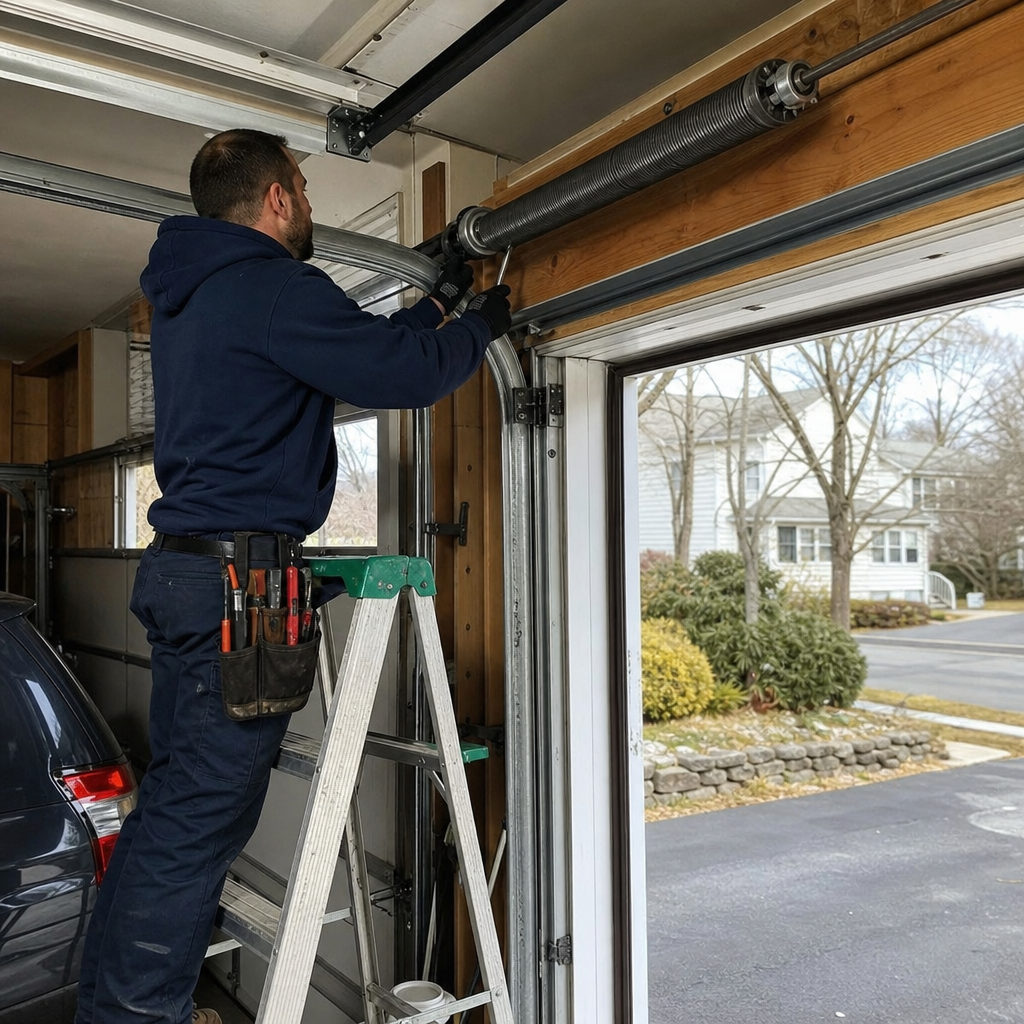
A garage door cable isn’t a universal part. The correct gauge depends on door weight, height, and drum type. A standard 16×7 steel panel door in a newer West Hartford colonial might use 1/8″ aircraft cable rated for 1,200 pounds. A heavy Clopay or Amarr carriage-house door with overlay panels and decorative hardware can push 300+ pounds — that needs 5/32″ or even 3/16″ cable, with different drum specs to match.
Mark stocks both standard and heavier-gauge cables because Hartford’s housing stock demands it. The Victorian-era carriage houses in the West End — many converted to garages decades after they were built — often have non-standard opening widths and critically low headroom clearances. A cable that’s technically “correct” for the door weight but paired with the wrong drum for the available space creates uneven winding and premature fraying. This is where eleven years of single-trade focus pays off: we’ve worked on enough oddball openings to recognize when a catalog-standard replacement won’t cut it.
Hartford Cable Replacement Pricing
| Service | Price Range |
|---|---|
| Cable Repair / Replacement (standard door) | $130–$250 |
| Spring Repair (often paired with cable work) | $180–$340 |
| Bottom Seal Replacement (recommended winter protocol) | $110–$220 |
| Track Realignment (if cable slip damaged alignment) | $120–$240 |
| Full hardware inspection & tune-up | $150–$600 |
Pricing varies with door size, cable gauge, and whether we find secondary damage from the failure. We quote upfront before starting work — no surprises when the door is already stuck open at 7 p.m.
Common Local Scenarios We See in Hartford
The Triple-Decker Detached Garage (Frog Hollow, Barry Square, Behind the Rocks)
These narrow urban lots force garages against property lines with zero side clearance. When a cable snaps, there’s barely room to work — and often no room for a standard opener, which is why you’ll find jackshaft or low-headroom systems at far higher rates than in West Hartford or Wethersfield. We’ve replaced cables in spaces where we had to disassemble the bottom bracket in place because the door couldn’t be lowered past a concrete lip six inches from the neighbor’s fence. Mark’s familiarity with these constraints means we bring the right tools and don’t waste your time with approaches that assume suburban clearances.
The Converted Carriage House (West End, Asylum Hill)
Pre-automobile construction, 8-foot or sub-standard-width openings, limited headroom, hardware that predates modern torsion-spring systems — sometimes with original timber lintels that can’t handle the load of a standard steel door. Cables on these doors often run on obsolete winding systems or custom-fabbed drums that haven’t been manufactured in decades. We fabricate solutions when off-the-shelf parts don’t exist, and we know which modern hardware can be adapted without destroying the building’s structural integrity.
The Deteriorating Shared Garage (Asylum Hill, Upper Albany)
Two- and three-family homes built for rental use, with cheaper construction that’s now 80–100 years old. Dirt floors or severely cracked concrete, moisture from below, cables rusting at the drum before they ever see a freeze cycle. In these conditions, cable life is half what you’d expect in a dry, newer attached garage. We address the environment, not just the part — because replacing a cable on a door that’s effectively sitting in a damp cellar is throwing money at symptoms.
Can You Replace a Garage Door Cable Yourself? Here’s Our Honest Answer
We’re not going to pretend this is like changing a furnace filter.
Garage door cables are under hundreds of pounds of stored torsion spring force. When a cable is intact, that force is distributed and controlled. When a cable has snapped or slipped, the remaining cable and spring are holding uneven, unpredictable tension. The winding cone on a torsion spring can release violently if handled incorrectly — we’ve seen broken wrists, facial injuries, and worse from homeowners who watched a video and thought they understood the mechanics.
The specific danger with cable work is that you’re often working at the bottom bracket with the door in an unstable position. If the spring releases or the door shifts, there’s no safe direction to move. This isn’t electrical work where you can throw a breaker, or plumbing where the worst case is a wet floor. The energy stored in a garage door system is mechanical and immediate.
Our recommendation: call a trained professional for cable replacement. The $130–$250 cost includes not just the part and labor, but the liability transfer — if something goes wrong, it’s on us, not you. Mark carries the specific tools for controlled spring tension release and has done this enough to recognize when a door’s condition makes standard procedures unsafe. That experience is what you’re paying for.
If you want to do something yourself while waiting for service: disconnect the opener (pull the red release handle), lock the door in the down position with vice grips on the track if you need security, and don’t touch the cables or springs. That’s it. Everything else waits for someone with the right training and tools.
How to Tell If Your Cable Is Failing Before It Snaps
Not every cable dies catastrophically. Watch for these warning signs, especially heading into Hartford’s freeze-thaw season:
- Fraying at the drum: Look where the cable wraps around the drum — individual strands separating, rust blooming at the contact point, or a “bird’s nest” of loose wires. This is the failure point we see most often in Hartford’s moisture-prone older garages.
- Door hanging unevenly: One side lower than the other when closed, or visible sag on one cable. Uneven tension means one cable is doing more work and will fail first.
- Slack cable on one side: The cable should be taut with the door down. Visible slack usually means a spring balance issue or a cable that’s stretched beyond specification.
- Rust staining on the door or floor: Even if the cable looks intact, rust runoff indicates internal corrosion — particularly common in garages with dirt floors or cracked concrete that wicks moisture.
Catching these early saves the emergency call. A frayed cable replaced during regular hours costs the same $130–$250. A cable that snaps at 10 p.m. on a Saturday, with your car trapped inside and a storm coming, costs more in stress than in dollars — though we’re available for that too.
Why Coastal Garage Door Repair Handles Cable Jobs Differently
Mark Thompson grew up in Hartford’s West End, about a mile from Elizabeth Park, and he’s been fixing things with his hands since he could reach a workbench. He picked up his foundational mechanical and electrical skills at Asnuntuck Community College in Enfield, then spent the better part of his twenties working alongside a veteran installer who taught him that a garage door is only as good as the hardware holding it together. For the past eleven years, Mark has been the guy Hartford homeowners call when a spring snaps on a January morning or a cable frays without warning.
Here’s what that means practically:
Mark shows up personally. Not a subcontractor, not a trainee with a script. The owner, the decision-maker, the person who’ll answer if there’s a follow-up question six months later.
We work on your brand. Chamberlain, Genie, Clopay, Amarr — we’ve diagnosed and repaired systems from all eight major manufacturers. We know which opener-cable interactions are common failure points and which are design quirks to work around.
11 years, one trade. Not a generalist who “also does garage doors.” Every day for eleven years, door systems, spring physics, cable geometry, opener logic. That depth shows in diagnostic speed and repair durability.
Nearly 1,000 neighbors have trusted us. 937 reviews at 4.8 stars isn’t a lucky streak — it’s consistent, repeatable quality from a process we’ve refined across thousands of Hartford-area doors.
When your door won’t move, we do. Emergency garage door service is built into how we operate, not a marketing afterthought. A cable failure that traps your car or leaves your garage unsecured gets priority response.
We also carry the full inventory of Garage Door Parts needed for same-day completion — cables, drums, bottom seals, hardware kits — so you’re not waiting for a second visit while your door sits half-functional.
FAQs
Standard cable replacement runs $130–$250 in the Hartford market, with most residential jobs falling in the middle of that range. Heavier carriage-house doors or non-standard drum setups may run higher due to thicker gauge cable and additional labor. We provide exact quotes before starting — call (833) 569-0621 for a free estimate.
Yes, same-day service is standard for cable replacements in Hartford, and emergency response is available when a failure blocks your car or compromises security. We stock multiple cable gauges and drum types because Hartford’s mixed housing stock — from triple-decker detached garages to converted West End carriage houses — doesn’t allow one-size-fits-all assumptions. Call (833) 569-0621 — we’ll confirm parts availability for your specific door and schedule.
Garage door cables are replace-only components — there’s no effective “repair” for a frayed or snapped cable. The cost question is really whether the cable failure damaged other parts (drum, bottom bracket, opener trolley) that also need attention. In Hartford’s winter conditions, we often find that a frozen-seal event that snapped the cable also warped the seal or grooved the drum. Addressing only the cable saves money today but guarantees a repeat failure. We’ll show you what we find and let you decide.
In optimal conditions — dry attached garage, standard use, quality installation — garage door cables typically last 8–12 years. In Hartford’s older urban garages with dirt floors, cracked concrete, or poor drainage, we’ve seen cables fail in 3–5 years from drum corrosion alone. The freeze-thaw cycles in Connecticut River Valley frost pockets add another wear factor: repeated cold-morning tension spikes when seals freeze to the apron. Proper bottom seal maintenance and concrete drainage can extend cable life significantly — ask us about this during your service call.
Ready to Get Your Door Moving Again?
A snapped or frayed garage door cable isn’t something to sit on — the remaining cable and spring are now handling unbalanced load, and the next cycle could damage your opener or create a safety hazard. Call (833) 569-0621 now for a free estimate. Mark Thompson will answer personally, confirm your door details, and get you scheduled — usually same day, always with upfront pricing and no pressure to add work you don’t need. We’ve been keeping Hartford’s garage doors running for eleven years, and we’re ready when you need us.
Written by Mark Thompson, Owner & Lead Technician at Coastal Garage Door Repair Greater Hartford, serving Hartford, CT.