
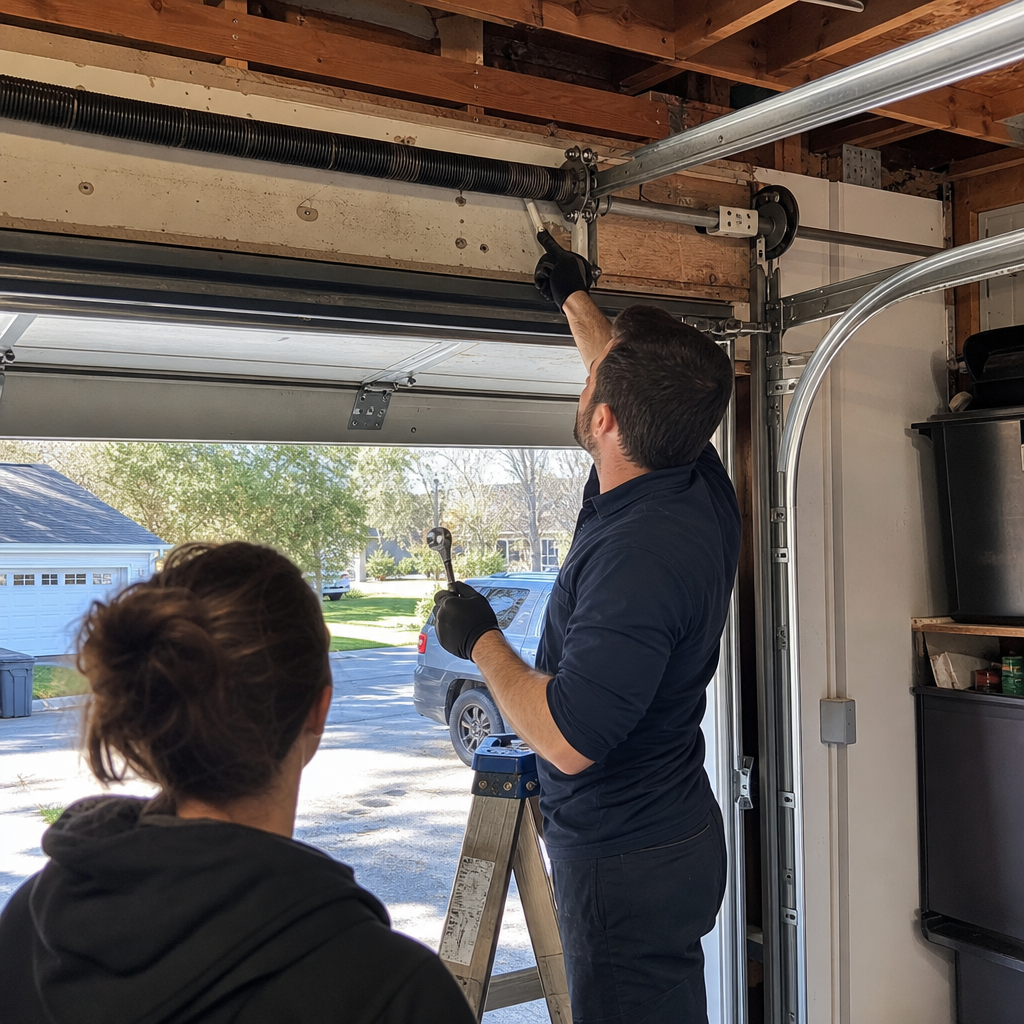
Why Does My Garage Door Reverse Before Closing in Hartford, CT?
Your garage door reverses before hitting the floor because the opener’s safety system detected either (1) an obstruction in the photo-eye sensor beam or (2) excessive mechanical resistance triggering the force-limit setting. In Hartford’s winter months, the second cause dominates: bottom seals freeze to concrete aprons overnight, creating resistance spikes that fool the opener into reversing exactly as designed. Call (833) 569-0621 for same-day diagnosis — we’ll determine which category you’re dealing with in about five minutes.
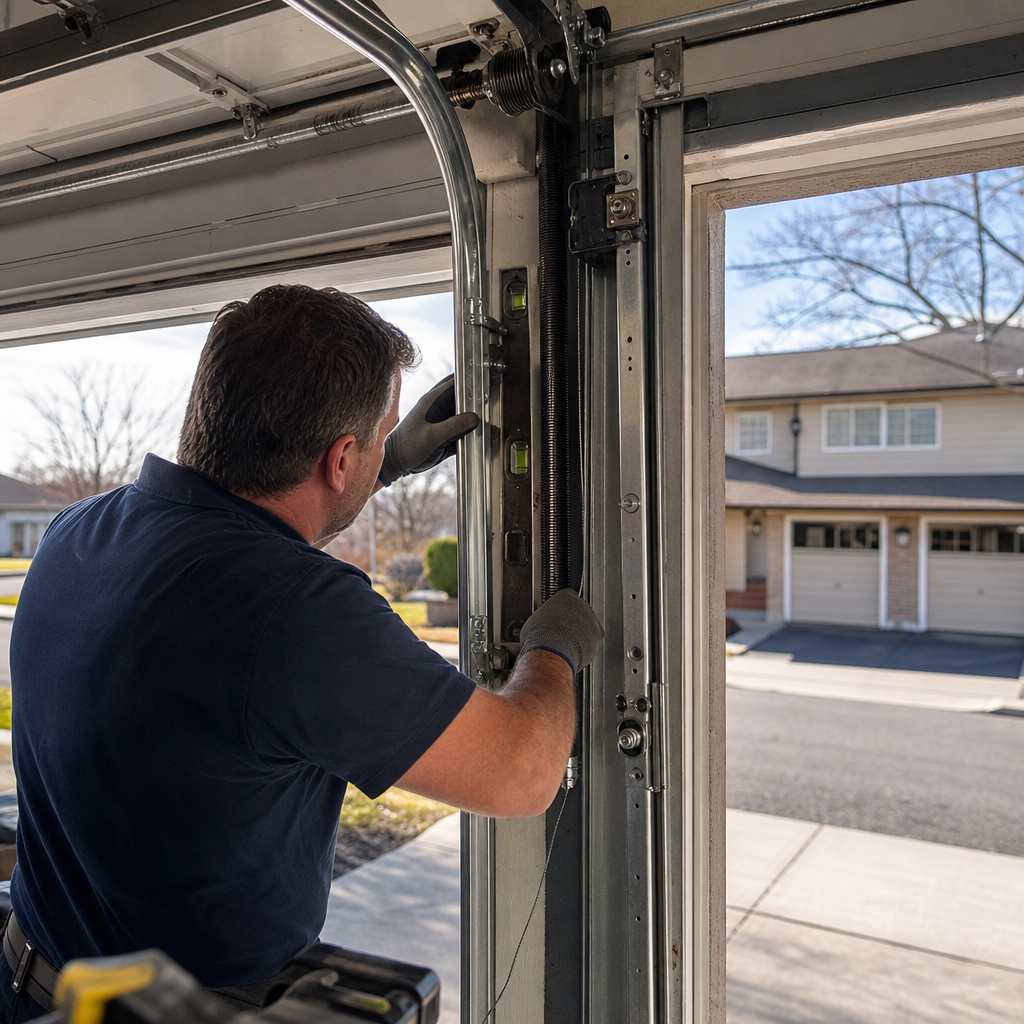
Last January, a homeowner in Hartford’s West End called us at 7 a.m. because her Craftsman opener had reversed three times that morning. By noon, it closed fine. By 3 p.m., she’d forgotten about it. Next morning, same reversal. She’d already cleaned the sensors twice. What we found: the rubber bottom seal had partially bonded to her concrete apron from a 22°F overnight low — common in Hartford’s Connecticut River Valley frost pocket, where inland temperatures drop sharper than coastal New Haven or Bridgeport. The opener wasn’t malfunctioning. It was doing its job, reading that resistance spike as a potential obstruction. The real problem was outside the door, not in the electronics.
That’s the pattern we see dozens of times each winter across Hartford neighborhoods from Frog Hollow to Asylum Hill. Understanding whether you’re dealing with a sensor issue or a force-limit trip saves you from replacing parts that aren’t broken and fixes that don’t last.
The Two Real Categories of Reversal Causes
Every garage door reversal falls into one of two buckets. Misdiagnosing which one you’ve got leads to wasted money and, worse, potential safety hazards if you start adjusting force settings to mask a mechanical problem.
Category 1: Photo-Eye Sensor Obstruction or Misalignment
Those two small boxes near the floor on each side of your track shoot an invisible beam across the door opening. Break that beam, and the opener reverses immediately — usually within the first foot of travel. Common sensor triggers in Hartford include:
- Leaf debris from autumn maples and oaks that blows into garages during fall cleanup season
- Snowmelt refreezing into ice patches that reflect or block the beam
- Sensors knocked slightly askew by garbage bins, bikes, or car bumpers in tight urban garages
- Corroded wire connections from Hartford’s freeze-thaw moisture cycling
The telltale sign: your door starts down, reverses almost immediately, and the opener light flashes in a repeating pattern (typically 10 flashes for LiftMaster and Chamberlain units, the two brands we encounter most in Hartford’s housing stock). If the door never gets more than 12 inches off the ground before reversing, you’re almost certainly in Category 1.
Category 2: Force-Limit Trip From Excess Mechanical Resistance
This is where Hartford’s climate becomes the main character. Your opener monitors how hard it’s working to move the door. Exceed the programmed force threshold, and the opener assumes it’s hitting an obstruction — a kid, a pet, a bike — and reverses to prevent injury. The door may travel two feet, four feet, or almost to the floor before reversing. The key difference from Category 1: the reversal point varies or correlates with specific conditions.
In Hartford, we see three mechanical resistance patterns that trigger force-limit reversals:
Frozen bottom seal bonding. When overnight lows drop below 28°F — which happens significantly more often in Hartford’s inland frost pocket than in coastal Connecticut — rubber bottom seals can partially freeze to concrete aprons. The first morning opening attempt tears the seal free or triggers reversal. By noon, ambient warmth or sun exposure releases the bond, and the door operates normally. This is the “works fine by afternoon” pattern that fools homeowners into thinking the problem resolved itself.
Track friction from corrosion and debris. Hartford’s older urban neighborhoods — West End, Frog Hollow, Asylum Hill — are heavy with pre-automobile housing stock where garages were converted from carriage houses or built as small detached structures 80–100 years ago. These garages often have tracks that have never been replaced, accumulating rust, hardened grease, and debris. Winter makes this worse: metal contracts, clearances tighten, and rollers bind in corroded sections. The opener strains, hits the force limit, reverses.
Torsion spring fatigue increasing door weight. Springs counterbalance your door’s weight. As they weaken — accelerated by Hartford’s sharp freeze-thaw cycles cycling metal through expansion and contraction — the opener bears more actual load. A door that once needed 10 pounds of opener force now needs 25. The force limit, still set for the original lighter load, trips.
The 30-Second Morning Test Every Hartford Homeowner Should Know
Before you call anyone — before you adjust anything — run this test Mark Thompson developed after eleven years of walking into Hartford garages where homeowners had already replaced sensors, circuit boards, or entire openers unnecessarily.
Step 1: Disconnect the opener by pulling the red emergency release cord. The door should move freely by hand.
Step 2: Lift the door halfway manually and release. A properly balanced door stays put. If it crashes down or rockets up, your springs are the problem, not your opener.
Step 3: Run the door through its full travel manually, feeling for binding, grinding, or resistance points. Pay special attention to the bottom 6 inches — that’s where seal freezing and track debris concentrate.
Step 4: Reconnect the opener. Hold your hand over one sensor, then the other. The opener should refuse to run with either beam broken. If it runs anyway, your sensors are miswired or failed — a rare but real Category 1 cause.
If the door moves smoothly by hand but reverses under power, you’ve isolated the problem to opener settings or an electronic fault. If the door binds or resists manually, you’ve got a mechanical issue that no sensor cleaning or force adjustment will permanently solve.
Why Hartford’s Freeze-Thaw Cycle Makes This Worse
Hartford sits in a Connecticut River Valley frost pocket. The geography is simple: cold air drains downriver and pools, while coastal cities benefit from maritime temperature moderation. The result: Hartford averages 15–20 more nights below 28°F annually than New Haven, and those sharp drops create the exact conditions that bond bottom seals to concrete.
The rubber compound in standard bottom seals stiffens below 30°F. Any residual moisture between seal and concrete — from snowmelt, rain, or even condensation — flash-freezes into a bond that takes 15–30 pounds of breakaway force to release. Your opener’s force limit is typically set around 20–25 pounds for safety. Do the math: the seal wins, the opener reverses, and you stand in your driveway wondering why your garage door has developed a mind of its own.
We’ve replaced bottom seals torn completely in half from repeated freeze-thaw cycles in Hartford’s West End and Asylum Hill, where carriage-house conversions often have slightly uneven concrete aprons that trap more moisture. In Frog Hollow’s triple-decker neighborhoods, detached garages built flush against property lines on narrow lots get minimal sun exposure, keeping them colder longer into the morning.
The fix isn’t cranking up opener force. That’s a workaround that creates a hazard — a door that ignores legitimate obstructions because you’ve trained it to push through resistance. The fix is addressing the mechanical cause: replacing hardened seals with cold-flexible vinyl compounds, adjusting threshold drainage, or in chronic cases, installing a low-wattage heat trace along the apron edge.
Adjusting LiftMaster and Chamberlain Force Settings: What You Need to Know
These two brands dominate Hartford’s housing stock — we’d estimate 60–70% of the openers we service fall under one label or the other. Both use similar force-limit systems, and both have adjustment procedures that are straightforward but potentially dangerous if misapplied.
On most LiftMaster and Chamberlain chain- or belt-drive units built since 2010, you’ll find two adjustment screws or dials on the opener housing: one for up-force, one for down-force. The down-force control is what matters for reversal issues. Turning it clockwise increases the force threshold before reversal.
Here’s the critical caveat we explain to every Hartford homeowner who asks about DIY adjustment: increasing force to compensate for mechanical resistance is a workaround, not a fix. If your door is reversing because of frozen seals, corroded tracks, or weakening springs, raising the force limit simply overrides the safety system that’s protecting your family. A door set to 40 pounds of force — enough to push through a frozen seal — won’t reverse for a child’s bicycle or a pet that wanders into the opening.
We won’t walk you through the full adjustment procedure because we’ve seen the aftermath: doors that crushed storage bins, doors that failed to reverse for obstructions, doors that damaged themselves by slamming into mechanical stops with excessive force. If I wouldn’t put it on my own garage, I won’t put it on yours.
What we will do: diagnose whether your reversal is a legitimate force-limit issue requiring mechanical repair, or whether your opener’s settings have drifted from age and vibration and need recalibration. That’s a distinction that requires hands-on assessment, not a web article.
When Reversal Patterns Tell You Exactly What’s Wrong
After eleven years in this trade, Mark Thompson has learned that reversal timing is diagnostic gold. Here’s what the pattern reveals:
| Reversal Pattern | Most Likely Cause | Typical Hartford Context |
|---|---|---|
| Reverses immediately, within 12 inches | Photo-eye sensor obstruction or misalignment | Leaf debris, ice reflection, or sensor knocked by tight garage maneuvering |
| Reverses at consistent point in travel | Mechanical obstruction: track damage, roller failure, or spring imbalance | Corroded track section in older carriage-house conversions; spring fatigue in 15+ year old systems |
| Reverses randomly, different points each time | Intermittent sensor issue or failing logic board | Moisture intrusion into sensor wiring from freeze-thaw cycling |
| Reverses only on cold mornings, works by afternoon | Bottom seal freezing to concrete apron | Hartford frost-pocket conditions, especially in shaded or north-facing garages |
| Reverses near floor, consistently | Force limit set too low OR floor-level mechanical binding | Threshold debris, seal compression, or concrete heave from frost penetration |
If your reversal happens at the same point in the travel every time, that’s mechanical — track, spring, or roller. If it’s random, lean toward sensor or electrical. Either way, if it’s persisted more than a week, your door is signaling a problem that needs diagnosis, not just a reset. Mechanical issues worsen; they don’t self-heal.
What Professional Diagnosis Actually Costs in Hartford
We’re transparent about this because “call for pricing” frustrates people who are already dealing with a malfunctioning door. Our service call and diagnostic assessment in Hartford runs within our standard garage door repair range of $150–$600, with most reversal-specific repairs falling toward the lower end:
- Sensor realignment or replacement: $120–$240 (often just labor if wiring is intact)
- Track cleaning, lubrication, and minor straightening: $120–$240
- Bottom seal replacement with cold-flexible compound: $110–$220
- Opener force recalibration after mechanical repair: Included with service call
- Spring adjustment or replacement if fatigue is the root cause: $180–$340
We don’t charge for callbacks if the first fix doesn’t hold — that’s rare, but it happens with intermittent electrical issues, and we’d rather eat the trip than lose your trust. Nearly 1,000 neighbors have trusted us across 937 reviews averaging 4.8 stars, and that repeat-call rate is a big reason why.
When your door won’t move, we do. Emergency garage door service is built into how we operate, not just a line on our website. Mark shows up personally on every job — he’s the decision-maker on site, not a subcontractor you’ve never met. We work on your brand, whether that’s a LiftMaster from 2019 or a Raynor that’s been humming since the Clinton administration.
FAQs
Your garage door reverses in cold weather because the rubber bottom seal has partially frozen to the concrete apron, creating resistance that triggers the opener’s force-limit safety reversal. Hartford’s inland frost-pocket position produces sharper overnight lows than coastal Connecticut cities, making this pattern far more common here than in New Haven or Bridgeport. The seal typically releases by afternoon as temperatures rise, which is why the problem seems to “fix itself” — but it will return with the next hard freeze. Call (833) 569-0621 for a seal assessment; estimates are free.
No — adjusting the force limit to overcome mechanical resistance disables the safety system that protects against entrapment and can create a hazardous condition where the door fails to reverse for legitimate obstructions. In Hartford’s winter conditions, homeowners who crank up force settings to push through frozen seals often end up with doors that crush objects or injure pets. The correct fix is addressing the mechanical cause (seal replacement, track service, or spring repair) and then recalibrating force to factory specifications. We handle this calibration as part of any mechanical repair — call (833) 569-0621 to schedule.
Disconnect the opener using the red emergency release cord and operate the door manually: if it moves smoothly through full travel, the problem is likely sensor-related or an opener setting; if you feel binding, grinding, or resistance, especially in the bottom section, you have a mechanical issue. Doors that reverse immediately (within 12 inches) typically indicate sensor obstruction, while reversals at varying or consistent points higher in the travel suggest force-limit trips from mechanical resistance. For a definitive diagnosis in Hartford, garage door repair assessment from Coastal Garage Door Repair takes about five minutes on site — call (833) 569-0621.
Most reversal repairs in Hartford fall between $120 and $340, depending on whether the cause is sensor realignment, track service, bottom seal replacement, or spring adjustment. Our full diagnostic and service call is within the $150–$600 garage door repair range, and we provide upfront pricing before any work begins. If your opener requires force recalibration after mechanical repair, that’s included — we don’t nickel-and-dime for safety settings. Call (833) 569-0621 for an exact quote; estimates are free.
Yes — we carry sensors, seals, rollers, and common hardware for LiftMaster, Chamberlain, Genie, and Raynor systems on our service vehicles, and most reversal issues resolve in a single visit. Mark Thompson, our owner and lead technician, handles emergency garage door service calls personally, so you’re getting the decision-maker on site, not a rotating subcontractor. For same-day service in Hartford, call (833) 569-0621 before noon; afternoon calls typically schedule for next-morning arrival.
If you’d rather have it looked at, Coastal Garage Door Repair Greater Hartford offers a no-pressure assessment in Hartford — call (833) 569-0621.
Written by Mark Thompson, Owner & Lead Technician at Coastal Garage Door Repair Greater Hartford, serving Hartford, CT.